
Maria Montessori
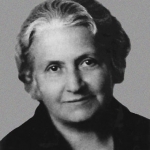
In 1907, Maria Montessori, the first woman to graduate in medicine in Italy, established the first “Casa dei Bambini” for young children in the working-class neighborhood of San Lorenzo in Rome. Through observations, research, and experimentation, Maria developed and refined her pedagogy based on two main principles: the absorbent mind and sensitive periods for ages 3-6; and moral awareness and intellectual independence for ages 6-12.
The Absorbent Mind
- Children between the ages of 3 and 6 have the conscious ability to absorb large amounts of information from their environment.
- This absorption occurs through their five senses. Educators aim to nurture this “absorbent mind” with appropriate sensory materials.
- This freedom of absorption allows children to build their inner security, independence, and intelligence.
Sensitive Periods
- “These are special sensitivities found in beings undergoing evolution, that is, in stages of childhood. They are temporary and limited to the acquisition of a particular trait.
- Once this trait is developed, the sensitivity ceases.” Sensitive periods include order, movement, sensory refinement, language, and social development.
- We provide children with an environment that caters to their sensory qualities and is adapted to their sensitive periods.
Moral Awareness
- Children between the ages of 6 and 12 have a strong sense of justice. They want to distinguish “right” from “wrong” on their own, understanding what is acceptable or not.
- The classroom is a miniature society that organizes and develops its own rules, where the child questions and develops their moral judgment and personal ideas.
- This is also an age when imagination flourishes. Children develop a particular interest in “heroes.” This creative faculty allows the child to transition to abstraction.
Intellectual Independence
- Children between the ages of 6 and 12 are curious about everything. They want to understand the world and the universe without limits. It is a time of cultural acquisition, an extremely receptive period for learning.
- Children are interested in the relationships between elements, and Montessori pedagogy offers them a comprehensive, coherent, and unified view of the world.
- Their reasoning mind needs to be exercised in an intellectually and physically expanded environment (universal education and the external world).


Bibliography
